

Lloyd’s ELTO employers’ liability return
United Kingdom
Checks UK employers’ liability policy returns before they’re reported to the Employers’ Liability Tracing Office.
From Lloyd’s ELTO template for reporting UK employers’ liability policies
- 25validation rules
- 5pipeline stages
- 22columns
- 2 minto build and check
See it in Quantemplate
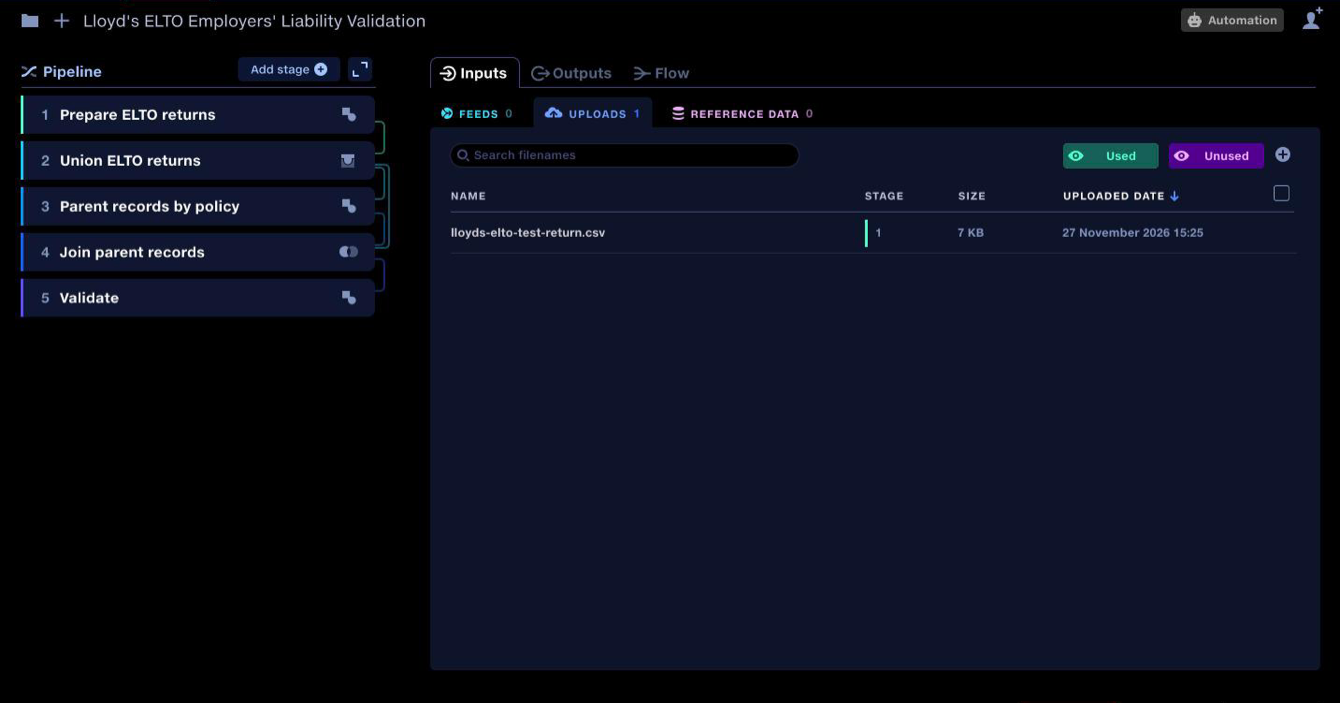
The pipeline
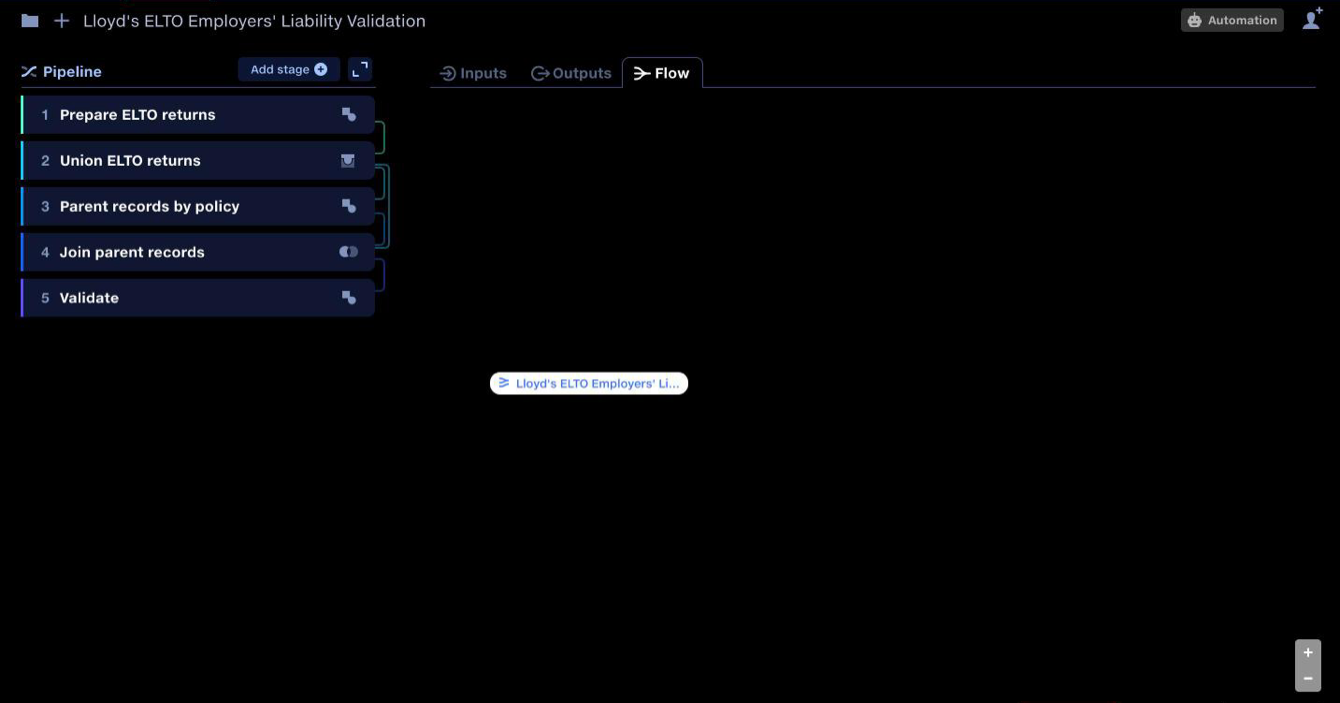
The flow
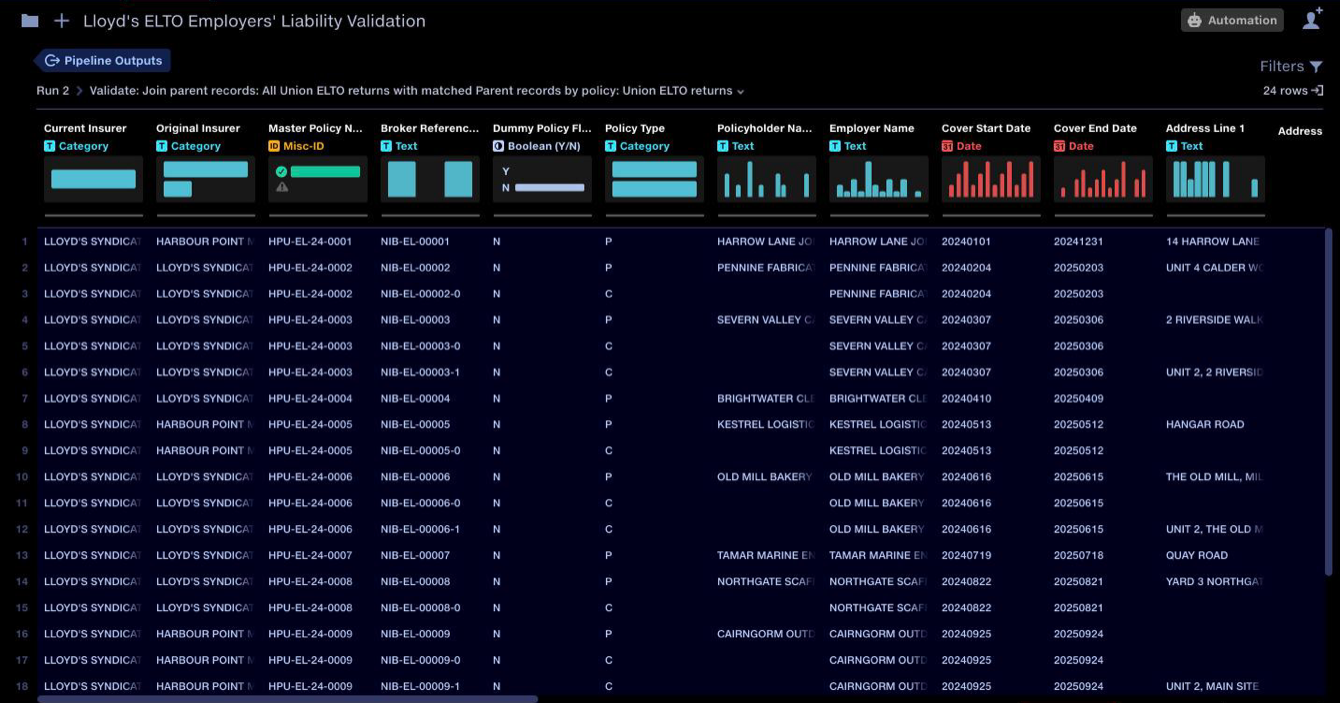
The checked output
What it checks
25 rules 21 Fail 4 Warning
- Mandatory fieldsFields flagged M aren’t blank 10 Fail 10
- Codes and formatsY/N flags, policy types, policy numbers and employer references 4 Fail, 1 Warning 5
- Conditional fieldsCover dates, and fields needed on parent and child records 6 Fail, 1 Warning 7
- Parent and child recordsEach child sits within its parent policy’s cover 1 Fail, 2 Warning 3
A rule set to Fail marks its rows as failed, and any failure blocks Auto Export if you set it up. Warnings are only reported. Validation never removes a row. Every rule and its formula is listed in VALIDATIONS.md in the download.
How the pipeline works
- Stage 1 Prepare Tidy each return: headers, column names, text and dates
- Stage 2 Union Stack every return into one
- Stage 3 Parent records Find each policy’s parent record and cover dates
- Stage 4 Join Bring the parent’s details onto every row
- Stage 5 Validate Run the 25 rules
What’s in the download
- The 25 rules as JSON, and a table of every rule with its formula and notes
- Master schema data, and a test return with rows built to fail each rule
- The number of rows each rule should flag on the test return
- A Claude skill that builds the pipeline and checks the results
- A snapshot of the finished pipeline and the scripts that build it from your browser
- Lloyd’s template the rules are generated from (© Lloyd’s)
Build it
- Unzip the download and copy the folder in
skillsinto~/.claude/skills/. - With Claude in Chrome signed in to Quantemplate, ask Claude Code:
Build the Lloyd’s ELTO pipeline from the lloyds-elto folder.
- Claude creates the datasets and stages, runs the test data and checks every rule’s result. This takes around 2 minutes.
The agent builds through the Quantemplate app’s own API in your browser. That API isn’t published, so if a release changes it, the build stops and the agent offers to click through the screens instead, which takes much longer. Review what the agent builds before you rely on it.
Using real returns
- Add each ELTO return as an input to stage 1. Report each policy as a parent record (P), with a child record (C) for each subsidiary employer.
- The test data is made up. Employer Reference Numbers follow the PAYE format only.
Contact the Quantemplate support team, or use your AI agent, to build custom logic for your use case.
Limits
- It checks the data before it’s sent, not the submission. ELTO takes returns in its own format through its own channels.
- Three warnings are suggestions rather than the template’s notes: the Employer Reference Number format, a child with no parent in the returns, and a policy with two parents.
- Column types are set by the build, not detected from your data. Choosing the master schema again makes Quantemplate detect them, which may change some types.
- The build doesn’t set up Auto Run, Auto Export or feeds.
- The agent works through the app in your browser, so changes someone makes in the app whilst it’s working can trip it up.